Tuesday, January 10, 2012

Vermicomposting

What's the scoop? I heard you're feeding food scraps to worms.


Most of us are familiar with the concept of composting. The most basic method of composting began two thousand years ago back in the days of the Roman Empire. Organic waste would be placed in a pile after the harvest and would break down into compost by the next growing season. The composted waste material would then be spread around new crops as a source of nutrients. Modern day composting has evolved to produce compost more efficiently but the basics remain the same. Waste material is broken down by the microbial action of fungi and bacteria into plant nourishing nitrates and nitrites. Standard composting is a fairly slow process which can take up to 6 months.

There is a process called vermicomposting that is much more efficient and quicker than standard composting methods. vermicomposting is a composting method that relies on worms to process waste material.Worms native to the Glen Ellyn area are not very efficient breaking down plant material but there are a few non-native varieties that have voracious appetites for waste and are commonly known as Red Wigglers. The two red wiggler species available in the U.S. are Eisenia foetida and Eisenia andrei. Neither of these worm species can survive our cold winters so they need to be protected to survive our normal winter temperatures.

           Vermicomposting worms turn waste into compost much faster than the traditional composting process.

Large scale vermicomposting has been practiced in Canada, parts of Europe, Japan and the Philippines for many years. For the most part, only small scale vermicomposting is performed in the U.S. It's estimated more than 60,000 homes in the U.S. use some form of indoor vermicomposting. There are several types of worm composters available for homeowners who wish to turn their kitchen scraps into a composted material to use in their gardens. Small scale indoor vermicomposters can process a several pounds of kitchen scraps per week.

We are looking for a way to compost the majority of the restaurant waste produced at the Village Links Golf Course. It is estimated that 78% of restaurant waste could be recycled by vermicomposting. Everything from cardboard, to egg shells and egg cartons to vegetable scraps to coffee grounds and filters are easily processed in a vermicomposter. We are currently performing a small scale test to see how effective the vermicomposting process is.

Our test vermicomposter is made from simple plastic storage bins.

A view from the top shows compost and food scraps.  
 
We started composting waste 2 months ago and so far it looks like all is going well. We alternate layers of shredded paper/card board with food waste. Any 'clean' food waste can be composted. The system we utilize doesn't effectively compost meats, oils or fats. There is virtually no odor from the covered bin. If anything, there is a slight smell of fresh earth.

A blend of food scraps and coffee grounds are mixed with high-carbon items such as shredded paper and cardboard.

If all goes well with our small-scale experiment, we will construct or purchase a larger unit that can handle all of the compostable waste produced at our restaurant. Waste generated at the Village Links Restaurant and Halfway House will be brought to our maintenance yard each day where the composter will operate.


Eisenia foetida worms can compost food items like stale bread and potato peels rapidly. A large scale bin containing 100 lbs. of worms can process 75 to 100 pounds of waste per day.

Large scale industrial flow through vermicomposters are self contained units that eliminate odors and exclude nuisance wildlife. Flow through systems are easy to use. As organic waste is added, the worms process the waste leaving behind nutrient rich worm castings. The worms continue to move upward as new waste is added. Every few days, worm castings are harvested from the bottom of the unit. The resulting worm castings will be used to amend our flower bed soil mix and will be dried and spread on high traffic turf areas on the golf course.


Sustainable Agricultural Technologies Inc. produces industrial size vemicomposters used by schools, prisons and hospital cafeterias. This 5' X 6' unit is capable of processing 75 to 100 pounds of food waste each day.


It is our hope this program will divert substantial amounts of food scraps and kitchen waste from the landfill and provide us with some free organic fertilizer we can utilize on the golf course.

Thursday, June 30, 2011

Emerald Ash Borer

The Emerald Ash Borer (EAB) Agrilus planipennis was discovered in the western suburbs of Chicago several years ago and is an immediate threat to ash trees in the Glen Ellyn area. The EAB is a non-native pest first discovered in this country in Michigan 10 years ago. The pest is currently in 14 states and has killed an estimated 100 million trees to date. The entire genus of ash Fraxinus is at risk in North America.

The Village Links of Glen Ellyn has 420 ash trees on the property which is approximately 10% of our golf course tree inventory. While many experts feel it is not possible or too costly to protect ash trees from the EAB, it has been shown that if treatment is started early enough, ash trees can survive the current EAB infestation. The key is to begin treatment before the EAB becomes established in a tree and once treatment begins it needs to continue into the future. We have decided it is worth the expense and effort to protect our ash tree population.

It is important to understand the EAB life cycle if you want to keep it at bay. The adult beetles shown below emerge from an infected tree from mid May until late June. The adult beetle stage of the EAB does not cause any damage. They mate and lay approximately 200 eggs on the bark of a nearby ash tree. The eggs hatch into larvae which burrow through the bark and begin feeding on the tree's cambium layer located between the bark and the wood of the tree. This vascular layer is where water and sap flows from the roots to the tree top. If enough larvae are feeding in this layer, sap will stop flowing and the tree will die. The cambium layer is also the only route an insecticide can travel to kill the EAB larvae. That is why it is so important to begin treatment before a tree is infected. The larvae continue to feed on the cambium layer all summer and fall growing to about 1/2" in length. The EAB over winters in the larval stage, feeds for a short time in the spring, then pupates into the beetle form where it emerges to complete the life cycle.   

 Emerald Ash Borers Adults collected June 27, 2011

So how does the average homeowner decide what steps to take if they have an ash tree. The first step would be to identify the trees on your property to see if you have an ash tree. Remember, the EAB can kill all ash trees so it doesn't matter what type of ash tree you have. 


 This is a typical leaf cluster from an ash tree. Note the leaves join the stem in pairs. Many other trees have single alternating leaves staggered along the stem.


Once you have determined you have an ash tree in your yard you should assess it's over-all health and value in your landscape to help you figure if it's worth the expense and effort to keep your tree(s) protected. Is your tree currently healthy or does it have declining and broken branches? Does it have proper form or is it misshapen due to improper pruning or storm damage? Is the tree a prominent part of your landscape or is it hidden among a cluster of other trees? Is the tree in the proper location or is causing problems because it it too close to your house? If you want to keep the tree, you must take action now and continue treating your tree for the foreseeable future.

 
One of the symptoms of EAB is the formation of branch suckers close to or on the tree trunk. This tree in the Raintree Subdivision shows no other symptoms and may respond to treatment if immediate action is taken.

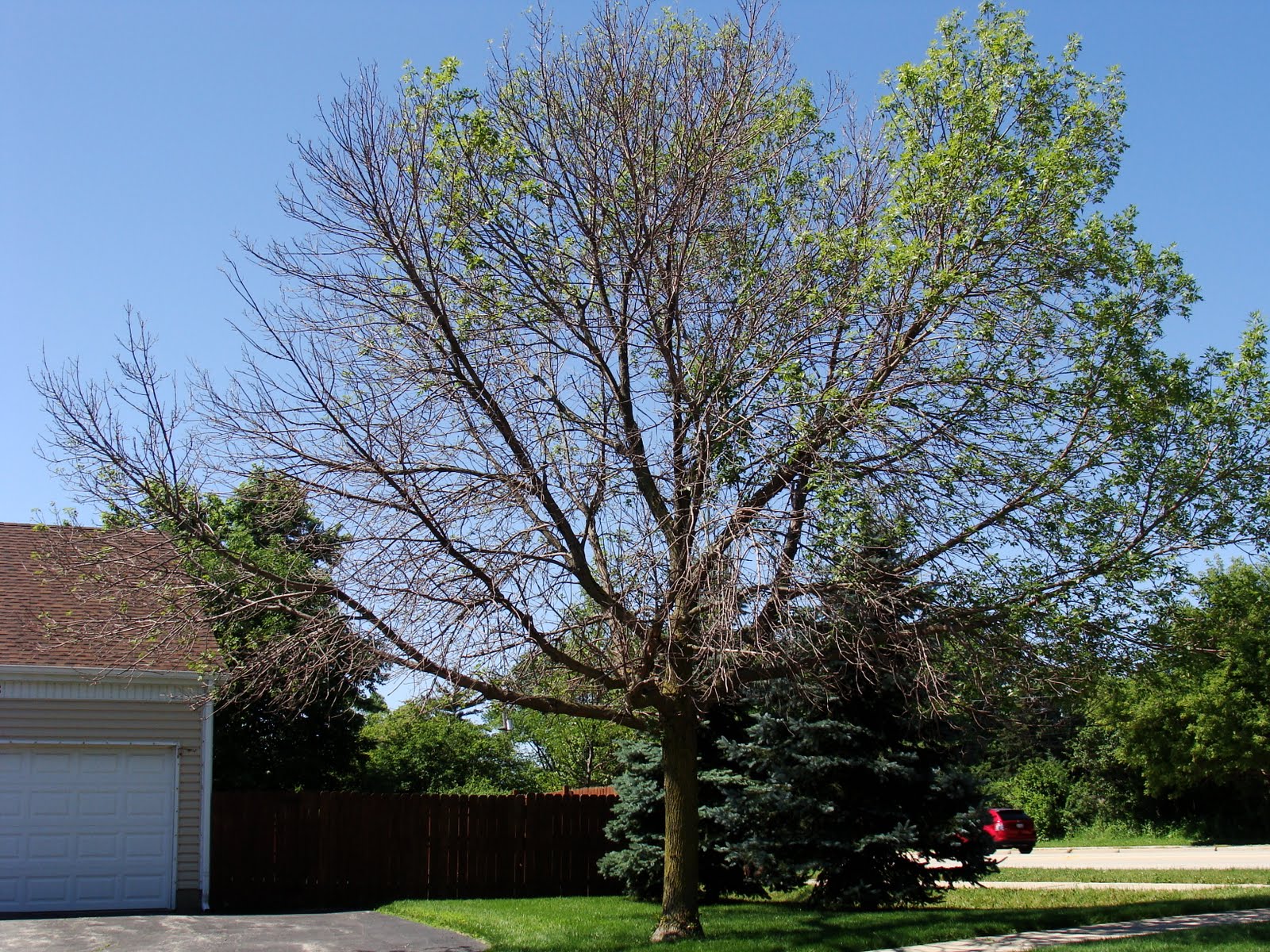
 This ash tree has been infected for 2 years. The entire interior branching structure has died making it a poor choice to try and save.


 This tree has been infected for 4 years. Only the trunk and a few branches on the right side are still alive.


This tree was treated with insecticide but not until it was infected with EAB for 2 years. Sadly, this ash tree will not recover.


Remember, if your tree is already 20% to 40% infected with EAB, it will most likely die even with treatment. There are several treatment options for preventing and controlling EAB. Professional tree care companies have access to insecticides that may be injected into the tree, applied as a bark penetrant or applied as a soil drench. The only EAB insecticide available to a homeowner is Bayer Advanced Tree and Shrub Insect Control. It is important to follow the label instructions when using this product. It is recommended the product be applied in the mid to late spring or in the mid fall period. The product is easy to apply. The insecticide comes in a small water soluble packet which is placed in a 5 gallon bucket of water. The packet quickly dissolves releasing the powder containing the insecticide. Simply stir the product thoroughly and pour around the base of the ash tree. It is best to make the application on a sunny day when there is a moderate amount of moisture in the soil.
For more information on EAB: http://emeraldashborer.info/
 

Friday, May 27, 2011

Organic Produce

"I heard you're growing tomatoes. Why don't you just stick to growing grass? Isn't that tough enough?"


Yes, we primarily grow grass but growing produce is a natural extension of our goal of operating the golf course in an environmentally sensitive manner. In the spring of 2011, we decided to see if we could successfully raise produce for the Village Links Restaurant. Our goal the first year is to break even on our investment of materials and labor. We feel if we break even on our costs the project is well worth doing because of the many benefits of raising your own produce. The vegetables we grow are naturally organic. No pesticides or chemicals are used on the plants. The growing method we employ uses much less water than traditional growing methods. Growing our own produce means no transportation costs and no fuel is used to deliver our produce. The produce we grow is also fresher and tastes better.

 Earthbox® containers on wood pallets.

We chose to grow our produce using the Earthbox® System. The system employs a raised container which wicks water from a reservoir at the base. The benefit of the bottom reservoir is that water is always available to the plant in ample supply but you cannot over-water your plants. Plants grown in Earthboxes® grow faster and larger than plants grown in traditional soil gardens because potting soil is used in the system.

One issue gardeners face in the Chicago area is the relatively short growing season. It takes up to 75 days for many vegetable plants to begin producing produce.To 'lengthen' the growing season we decided to place our Earthboxes® on wood pallets. This allows us to bring the plants indoors when there is the threat of frost and freezing temperatures. It takes less than 30 seconds to move a pallet of 3 Earthboxes® indoors. Protecting plants which are susceptible to frost extends the traditional growing season by a month in the spring and a month in the fall.

Plants are started by seed indoors during the late winter months.

It is very inexpensive to grow vegetable plants from seed. Growing your own plants also means you can control the types of produce you want and can have the plants ready to plant on your own timetable. Also, the plants you purchase from the store are rarely organic. 

 Butter Crunch Leaf Lettuce.

Plants grow quickly in the raised containers. Lettuce, parsley, arugula and cilantro mature in a few weeks.  Once the plants mature, they are harvested and new transplants are put into the Earthbox® containers. The containers last at least 10 years. The soil mix can be reused for at least 5 years before it needs to be replaced.

Lettuce seedlings ready for transplant.

We work with Mike Atkins, our restaurant manager, to choose vegetables which are easily grown, can be adapted to his recipes and can help offset his food costs. In 2011 we are growing a few varieties of lettuce, zucchini, several types of tomatoes, parsley, jalapeno peppers, arugula, bell peppers, basil, cucumbers and banana peppers.

 The first yellow pepper will be ready to harvest by June 1st.


 Tomato blossoms signal harvest is only a few weeks away.


 Trellises are in place to train the tomato plants.


Fresh arugula transplants will be used as a garnish and added to salads for a zesty taste.

 Our restaurant will realize significant savings when they no longer have to purchase expensive herbs like basil.

June Update - Four weeks later, the basil is a prolific producer.
 June Update - Four weeks later, the tomatoes are 5' high.

June Update - The 1st tomatoes are beginning to ripen.

July Update - Produce is harvested in the morning and is served
fresh within hours of being picked.

10 to 20 lb.s of produce is harvested each day. A typical harvest includes cucumber, zucchini, jalapeno peppers, banana peppers, tomatoes, parsley and gourmet bell peppers.

Monday, November 22, 2010

"The course is in great shape but why isn't there any grass left on the practice tee by August every year? "


The driving range tee is the most heavily used turf on the golf course. It is open every day from dawn until dusk, from mid March to the end of November. The simple answer to why turf conditions decline in August is the turf is removed faster from divots than can be replaced by new grass.


An aerial view of the driving range tee. The yellow dots show the current practice line. 
The front of the tee is at the bottom of the picture.
Each day the markers are moved back 6 feet to the next row.

The practice tee is 1.25 acres in size. Of the more than 2 million shots hit off the tee each year, an estimated 1.5 million shots result in a divot of turf removed from the surface. While divots come in all sizes, the average divot is 3" wide by 6.5" long, a total of 19.5 square inches.Over the length of the season more than 200,000 square feet of divots are removed from the tee. That's more than 4.5 acres of turf from a 1.25 acre surface. The only reason there is any turf on the tee is because of an intensive maintenance plan. 

The driving range tee is wide enough to accommodate 28 hitting stations each day. The marker rotation begins at the front of the tee surface and moves back 6 feet each day. The marker location keeps moving back each day another 6 feet. After 25 days, the markers have run out of room at the back and are rotated back to the front of the tee to start the rotation process all over. This allows only 25 days to regrow new turf before it will be used again for practice. Five days a week we seed the previous days divots. Different grass types are used depending on the time of the year. We use a variety of seed mixes containing perennial rye and Kentucky bluegrass blends. As we seed, a light mixture of soil, sand and humus is spread over the seed and leveled to provide an even surface. The seed germinates within a few days. During the cooler, wetter months of April, May, June, September, October and November, the grass fills in quickly due to high fertility levels and adequate moisture. In July and August when conditions become hot and dry, the grass seed often withers quickly after germination. To keep the new seedlings from dying we would have to water them every couple of hours making the tee unavailable for use. Some years we are able to maintain acceptable turf coverage on the tee even during the hot summer months. The hotter than normal summer temperatures of 2010 made it impossible to keep a good turf stand on the practice tee.

During July and August the tee surface becomes infested with Goose Grass and Crab Grass. These 2 weedy annual grasses easily invade turf stands that are weak. There are products to prevent these invasive grasses from germinating but they can't be used on the practice tee because that would also prevent the desirable grasses we plant from germinating.
The only way to improve the existing practice tee is to remove less turf. The good news is we can hit the same number of shots off the tee while making smaller divots. How?


"Practice Like a Pro"

Most of us take random divots on the practice tee. As was mentioned earlier, this removes a divot of 19.5 square inches each shot.


After just 30 shots, more than 4 square feet of turf is removed using the normal practice routine.

When you watch the pros practice you will notice they take their divots in a pattern. They place the ball directly behind a previous divot. This results in the 2nd divot being a much smaller size of 3" by 3". Each subsequent shot results in only a 3" by 3" divot.

The pros place the ball behind the previous divot. They will repeat this for up to 10 shots.
After 30 shots, the pros only remove 2.5 square feet of turf.

When you "practice like a pro" you remove 60% less turf. This keeps the tee in better shape all year but especially during July and August when the turf is the weakest. If all of us adopted the "practice like a pro" method we would reduce the annual divots removed from 203,000 square feet to just 93,750 square feet.

The best solution in the long term is to enlarge the tee surface but until then, please "practice like a pro". You'll be amazed at how your divots shrink.


Tuesday, August 10, 2010

" Why are our greens so slow. I heard they are only 9.5' on the Stimpmeter. I played at the Grass is Always Greener C.C. and they said their greens were running 12'. "

We try to maintain our green speed at 10' during the summer months. Any faster than 10' and we start to see putts rolling off steeper slopes on the greens. Fast greens are good until you start to see 3 and 4 putts. There are a few factors that determine how fast the greens putt. They are:

Height of Cut - The shorter the grass the quicker they roll.
Rolling Frequency - Rolling = speed.
Sand Top Dressing - Applying sand tightens up the turf canopy effectively making the grass shorter.
Fertility - Greens are faster with lower levels of fertility.
Weather - Dry weather & low humidity = fast, Rain & high humidity = slow.

The most important is height of cut. Our 18 hole greens are mowed at .118" height throughout the season. Every course has reasons for choosing their height of cut. Many Chicago area courses mow their greens higher and a few mow lower. We chose our height because we can insure the greens will be healthy and can recover from normal wear and tear.

The second most important factor is how often the greens are rolled. We roll the greens with a vibratory triplex roller. Each time we roll, the green speed increases 6". We normally roll 2 to 3 times per week often substituting rolling for mowing.

A vibratory roller smooths the green and increases Stimpmeter speed by 6".
This season it has been very difficult to find days when it is not too wet to roll. Rolling when the turf is too wet will cause the surface of the greens to compact. Once compacted, it is difficult for water nutrients and air to reach the turf's roots causing a rapid decline in quality. Rolling is also tough on the turf when temperatures are high. The turf on greens is under great stress in the summer heat. Rolling at the wrong time can cause a quick decline in plant health. The third factor that controls green speed is how often sand top dressing is applied.

A thin layer of sand is applied to greens to smooth the surface and reduce thatch build-up.

A light application of sand every 10 to 14 days keeps the greens rolling smooth and fast.


Sand top dressing is applied to greens every 10-14 days to control thatch build-up and to smooth the greens. We have only top dressed greens a few times this year because all the rainfall has made it difficult to find a window when conditions are dry enough to work the sand into the turf canopy.

Another key to maintaining a consistent green speed is controlling fertility levels in the grass plant. To avoid spikes of flush growth, we apply very small amounts of nutrients every 7 to 10 days throughout the growing season. Some golf courses will 'starve' their greens by applying very little fertilizer. This makes the green speed quicker but can result in poor turf conditions in the long term.

The last factor in determining green speed is the weather. High humidity and wet conditions result in a slower green speed because the grass blades hold more water and are thicker and wider than when the air is dry. We have experienced over 18" of rain during June and July. The excess rain has slowed the green speed down to 9.5' but fall is just around the corner and things should dry out and return to normal in a couple of weeks. Until then, we will do everything we can to keep the greens rolling smooth so you can enjoy your game.

And by the way, just because the Grass is Always Greener C.C. says their greens are running 12' on the Stimpmeter, doesn't make it a reality. It is very easy to manipulate the Stimpmeter to get any results your golfers want.

For more information on green speed:
http://en.wikipedia.org/wiki/Stimpmeter


Friday, March 5, 2010

"Business is tough. How do we spend less?" Updated October 2011

The economy has impacted all business the past couple of years. As a matter of fact, the golf business has been declining for the past decade due to the construction of  too many new courses and the improvement in golf equipment. The improved technology in golf equipment helps hit the golf ball a lot farther than in the past. Golf courses can on 'fit' 75% of the rounds they used to play in the past because players are spread out farther apart on the course. When you add these 2 factors to the current economic crisis, it is not surprising to see many golf courses closing. The Village Links has done an excellent job of recognizing the decline in golf and adjusting expenses accordingly. The Village Links may be the only public run facility in the nation that does not receive tax subsidies.We routinely work with all our vendors to receive the lowest possible price on all purchases. While there are many golf courses that make purchases because of personal relationships, we make purchases using efficient business practices. We never pay more for a product or service unless it is done ultimately to save us money in the long run or to provide an improved product for our customers.

Our staff has demonstrated fiscal responsibility for decades. We routinely implement procedures to reduce expenses. One example of this is our long time practice of recycling all of the wood chips produced by our staff and the Village of Glen Ellyn Forestry Division to be used for landscape mulch. This effort saves up to $40,000 per year. We also have an excellent track record of project management. The 5 million dollar 2001-2003 renovation of the golf course and irrigation system was below budget and on time. Our staff also completed $500,000 of ‘grow-in’ work at a substantial savings to the project.

While we have performed well in the past, I realize it is necessary to always find areas to improve. Since I became Grounds Superintendent in 2007, I have continued to devise ways to reduce expenses and improve our product. The Grounds and Mechanical Maintenance Division budget for fiscal year 2010-2011 is 37.5% lower than our budget 5 years ago. The following are examples of progress we have made in this area the past few seasons. We will continue to strive to reduce our expenses going forward.

 2007 – There is a triple basin sewer system in the storage building that captures dirt washed from turf maintenance equipment. The dirt includes grass clippings, sand, leaves and oil residue. The basin system removes the contaminants from the wash water before it enters the sanitary sewer system. Prior to 2007, we were paying $1,200 four times per season to have the build-up of contaminants removed from the triple basin system. We started using a bacteria that digests the grass clippings and leaves. This reduced the build-up of solids in the system reducing the waste removal cost to once per year. We also found a company that charges less for the removal process. We reduced our total expense from $4,800 per year to $450 per year. Annual saving is $4,350.

2007 – Many of the turf maintenance products are available in generic form at a significant savings. The generic products need to be tested for efficacy because even though they contain the identical Active Ingredients in the name brand products, the inert ingredients can differ.  We have been testing and converting to generic turf care products resulting in saving $8,000 to $12,000 per year. Annual savings $10,000.

2007 – Prior to 2007, our fuel supplier would make weekly in season deliveries to top-off our 3 fuel tanks. An average of 25 deliveries would be made per year. It costs approximately $75 per delivery for us to be present during delivery, process the paper work and have the invoice paid. In 2007 we reduced the number of deliveries to 10 by adopting an on-demand order system. Annual savings $1,125.

2007 – The restaurant kitchen sewer drains empty into a grease trap. The grease trap prior to 2007 required annual clean out to remove accumulated grease. Every other year, the main drain line would require sewer rodding to keep the system flowing. In 2007, we began using a bacterial grease digester bi-monthly. We have not had to perform any additional maintenance on this system for the past 3 years. Annual savings $1,950.

2007 – Approximately 5-8 seasonal staff members per day purchase their lunch at the golf course restaurant. Individual employees were each placing their order and often had to wait 10 to 15 minutes for their order to be completed. In 2007, we assigned the daily supervisor to take lunch orders before the morning crew is assigned their duties. The supervisor drops off all the orders at the restaurant and the orders are all ready for pickup at 10:30 A.M. Annual savings $750.

2008 – Com-ed bills a monthly Demand Charge for the 3 electric meters that feed our well and 2 pumping stations. We time spring start-up and fall shut-down of these systems to avoid monthly demand charges. Annual savings $2,500.

2008 – We began using synthetic blended motor and hydraulic oil in our equipment fleet. We were able to increase our equipment service intervals. Annual savings $6,000.

2008 – We researched and found an improved bearing grease for our equipment fleet. The more effective grease reduced bearing failure and replacement especially on mowing reels and rollers. Annual savings $3,000.

2008 – We supplement our irrigation water supply with a deep well. Prior to 2008 the well would automatically turn on when the water level in our north irrigation pond would drop 6 inches. We now control the well with a manual switch. Before we turn the well on we factor in current and predicted weather. Annual savings $1,000.

2008 –  We developed a program to reduce poa annua which is a weedy grass that has a negative impact on golf course turf. The program utilizes a turf growth regulator that in addition to reducing poa annua also slows the rate of growth of bentgrass turf. The slower growth of bentgrass turf which is used on our greens, tees and fairways allows us to reduce mowing frequency of these surfaces. Annual savings $24,000.

2008 – We have more than 500 bunker rake with fiberglass handles that wear out and need to be replaced every 3 to 4 years. In 2008 we began using a shrink wrap coating on the worn out handles to eliminate replacement costs. We also began using the shrink wrap on the golf green pins to improve their appearance and prolong their life. Annual Savings $1,200.

2008 – Prior to 2008 we used disposable tee towels on the club and ball washers on the golf course. We began using washable, reusable towels. Annual Savings $2,400.

2008 – Some of the items we purchase from traditional golf vendors can be purchased at a lower price from alternate sources, ie. a cocoa drag mat used in baseball field maintenance is the same mat used to drag in top dressing sand on golf greens. The cost of the mat is 50% less if ordered from a baseball field vendor. Purchasing items from non-traditional golf vendors saves 20% to 50%. Annual savings $1,000.

2009 – Higher fuel costs in recent years has resulted in higher shipping costs for deliveries. Since 2009 we have combined multiple orders into a single delivery to reduce shipping costs. Annual savings $1,500.

2009 – Our 2 fire sprinkler systems at the maintenance facility require inspection once per year. The inspection has to be performed by a certified company to meet fire code regulations. In addition to the annual inspection, the dry systems need to be drained and reset for maintenance and in the event of a compressor failure. This maintenance was previously performed by the certification company. Our staff researched and began performing the additional, non-certified maintenance at a significant savings. Annual savings $2,000.

2009 – The equipment parts solvent washer used for equipment maintenance and repair cost $1,500 per year for rental and servicing. In 2009 we purchased our own solvent washer and reduced solvent recycling from 8 times per year to 4 times per year. Annual savings $950.

2009 – The fairway mowing pattern was altered to reduce the number of times the mowers would have to lift their units and turn around to complete a mowing pass. Annual savings $1,600.

2009 – The task of hand mowing around trees on the golf course is labor intensive. In 2009 we experimented with an application of growth regulator around trees to slow turf growth. Annual savings $2,000.

2010 – An electronic, self calculating time clock was purchased. The new time clock will reduce math errors and save the labor to calculate payroll and produce paper time cards and labels. Annual savings $1,500.

2010 – A 12 volt, 25 gallon self contained sprayer was purchased to apply growth regulator around trees and mowed lake banks and to apply chelated liquid copper to suppress pond weed and algae. These applications were previously made with a 3 gallon hand pressurized sprayer. Annual savings $1,200.

2011 - A 12 volt variable speed fertilizer spreader was purchased to apply granular fertilizer in 'tight' areas on the golf course. Two small 50 pound capacity push spreaders were previously used to fertilize these areas. The new spreader is mounted on a turf truckster and has a 250 pound capacity. One operator can finish the same task which used to be performed by 2 people in 1/3 the time. Annual savings $620.

2011 - Following core aeration of our greens each fall, we topdress the greens with sand to fill in the aeration holes. Prior to last year it would take up to 20 man hours per green to work the sand into the aeration holes. We purchased a 'Fill'n'Sweep' rotating brush attachment which performs the same job in 1.5 man hours per green. Annual savings $8,000.  

2010 - 2011 - The grounds division operates 7 days per week. Our seasonal staff was scheduled to work 5, 8 hour days and 1, 4 hour day each week. This resulted in more than 600 overtime hours each year. Last year we changed the schedule to 5, 7 hour days and 1, 4 hour day each week for a total of 39 man hours. We now work less than 50 hours of overtime each year.

The operational changes we have implemented the past few seasons result in an annual savings of $80,000.

The golf market has gotten smaller each year for the past 10 years. Many golf courses have been slow to react to the reduction in revenue and find themselves in dire financial trouble. The Village Links has been fortunate to recognize the business trend and make appropriate cuts. During a time when golf courses are closing daily and virtually every municipal, county and park district run golf facility is subsidized by tax dollars, often to the tune of $500,000 to $1,000,000 per year, the Village Links still operates using no tax dollars. In addition to operating the golf course without tax money, Glen Ellyn Residents also benefit by receiving some of the largest resident discounts anywhere in the country. But perhaps the greatest benefit of our effort to be fiscally responsible is often not realized by our customers. Ten years ago the grounds crew worked 54,000 man hours to maintain the golf course. Due to our efforts to become more efficient over the last decade, we will work less than 30,000 man hours in 2011 to perform the same work and playing conditions are better than they were ten years ago. So next time you are playing golf, there is a good chance you won't see the grounds staff. Instead, you can concentrate on hitting that next great shot and having a fun, relaxing round at the beautiful Village Links of Glen Ellyn.

Friday, January 29, 2010

Greens Aerification

"The greens were perfect. Why did they have to tear them up? Now the greens are ruined"

Core aerification is the most disruptive maintenance activity a golfer faces. The golf industry has struggled for several decades, trying to find the best ways to minimize the impact to golfers. I recently 'attended' a live web-based meeting to discuss aerification. The meeting moderator began the session by stating the golf industry is being hurt by the misconception that aerification is a practice which leads to poor putting conditions and aerification isn't really that bad. He went on to say complaints were unfair to the hard working maintenance crews who performed the difficult work.

What? With all due respect to the moderator, our maintenance crew is supposed to work hard and aerification does ruin the putting surface, often for a several days. 

Serious golfers know the importance of aerification. It is a necessary short term disruption that has benefits that lead to long term improvements in playing conditions. It is our job to complete the process as efficiently as possible and take measures to quickly restore the putting surface so that normal playing conditions can resume. 

What is aerification? Aerification is any practice that pokes a hole through the turf canopy creating channels so water and air can move more freely to the root zone. There are several types of aerification. Some aerification methods are barely noticeable and most golfers don't even realize any aerifying occurred. 


Solid tine aerifiction, using 1/8" diameter solid tines to make very small holes in the surface, is performed once or twice per month at the Village Links.


The resulting holes are barely visible and do not impact ball roll.

Some greens have micro-climates including too much shade from large trees or water soaked root zones due to low lying compacted areas. These sites require more aggressive spiking using 1/4" solid tines to allow more air to reach the turfgrass roots. During this process, we only spike the portions of the greens that require it to keep them healthy. 
 

 The 1/4" solid tines are noticeable to players but putting is not impacted.

The aerification process that is dreaded by everyone is core aerifying greens. Cores spaced in a 2" X 2" pattern are removed using hollow tines up to 5/8" diameter. 


Turf on a golf green is highly maintained to provide a firm and smooth putting surface. The use of fertilizers and micro nutrients are necessary to help the turf recover from foot traffic wear and low mowing heights. The intense maintenance results in the development of thatch just below the surface. Thatch is an organic layer made up of dead and dying roots and grass plant parts. Thatch accumulation is a normal process in any turfgrass stand. A moderate amount of thatch is needed to hold the turf together but when too much thatch develops water is unable to penetrate the surface and roots will not get the nutrients, moisture and air they need to survive. Researchers have determined that when the organic matter in the the top 2" of the root zone contains more than 3.5% organic matter by weight, the turf conditions begin to decline to an unhealthy condition. If organic matter isn't reduced, the turf health will decline, reducing playing conditions. 
There are two ways to control the percentage of organic matter in the root zone. Mechanical removal of thatch through core aerification is the most efficient way. After the physical removal of the cores is complete, the resulting pattern of holes are filled with sand.


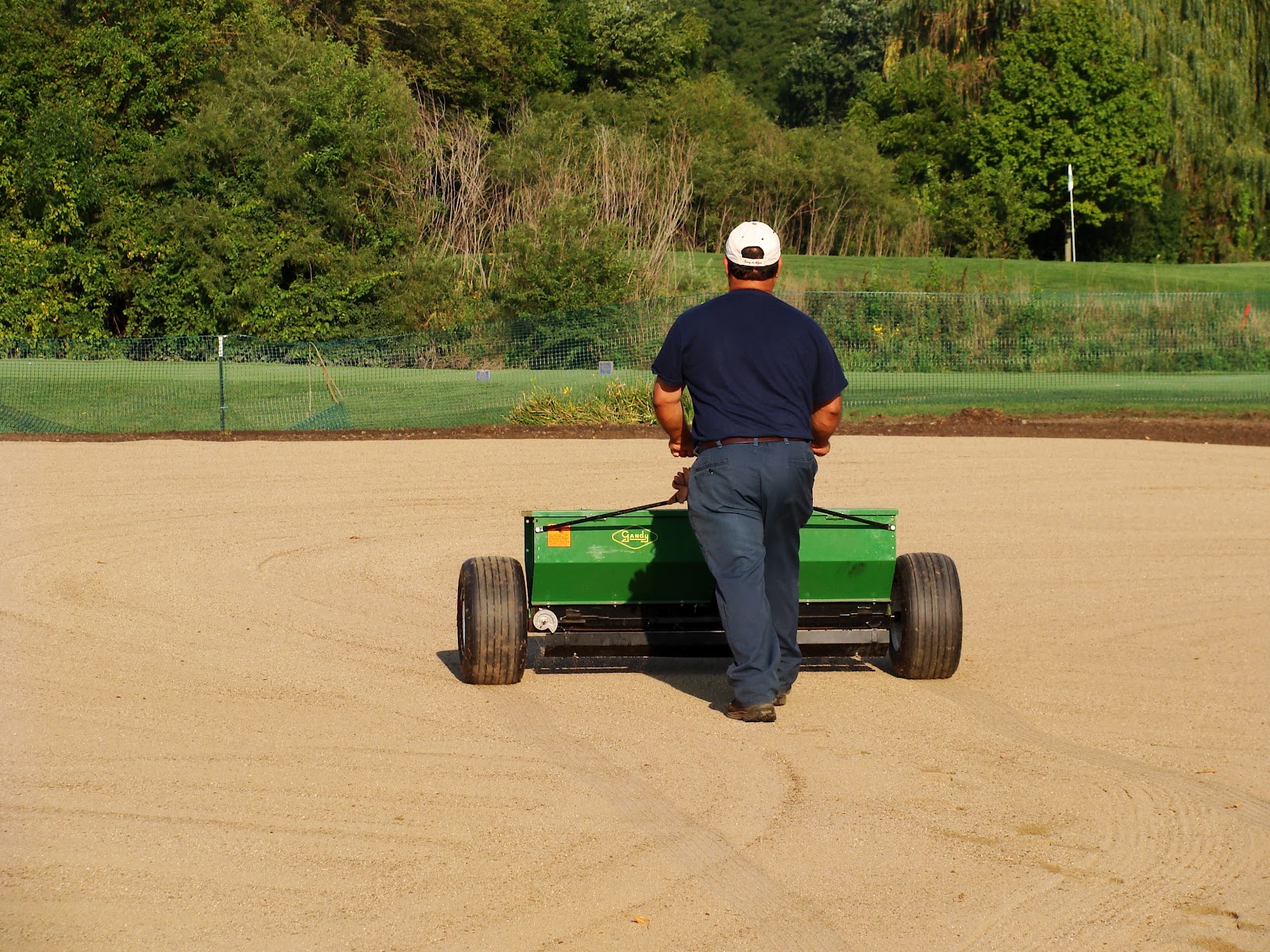
A layer of sand is spread on the green surface and brushed into the aerification holes.


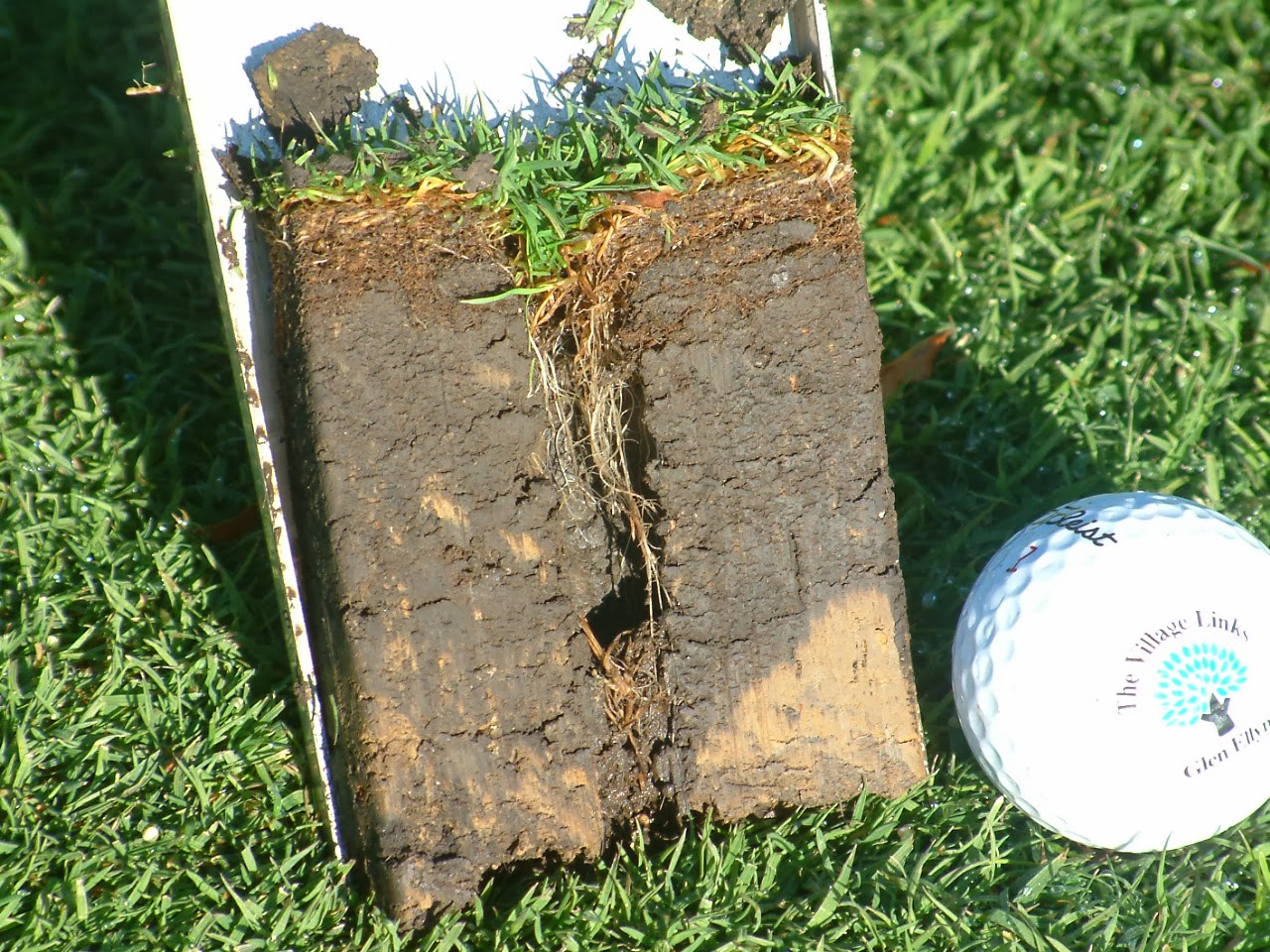
This profile of a golf green root zone shows the light colored sand which replaced an aerification core.

Sand filled aerification holes will slowly recover each day over a 2 to 3 week period if all goes well and putting will return to normal. This process may need to be repeated up to 3 times per season to keep organic content at proper levels. To reduce the need for core aerification, we make sure we don't over fertilize the turf and topdress the greens with sand lightly every 10 to 14 days. Light topdressing does not remove any thatch but helps dilute the organic matter content over time.


A very light layer of sand is applied to the greens 2 to 3 times per month. Vibratory rollers are used to push the sand into the turf canopy helping to dilute the organic matter build up in the root zone.